12 Weeks. Real Skills. Real Careers.
A direct, hands-on path from classroom to job site. Built around the curriculum, credentials, and professionalism that Kansas City employers demand.
Program Description
The Electrical Foundations Program is a 12-week, 192-clock-hour workforce training program designed to prepare students for entry-level employment or apprenticeship opportunities in the electrical industry. Students receive classroom instruction and hands-on lab training in electrical safety, electrical theory, hand and power tools, blueprint reading, National Electrical Code awareness, residential wiring, commercial wiring methods, conduit bending, electrical test equipment, troubleshooting, and workforce readiness.
Download Full Program CatalogAdmissions Requirements
Applicants must meet the following minimum admission requirements:
- Be at least 17 years of age at the time of enrollment
- Possess a high school diploma or Missouri-recognized equivalency, such as GED or HiSET
- Complete a brief admissions interview with school staff
- Submit a completed application and required documentation
- Provide proof of diploma or equivalency prior to official enrollment
- Provide valid government-issued photo identification
- Be able to safely participate in classroom and laboratory activities
Student Assessment
Student progress is evaluated throughout the program through a combination of classroom, lab, and credential-based assessments. Assessment methods include:
- Written quizzes and examinations
- NCCER module completion
- OSHA-10 completion
- Hands-on laboratory exercises
- Practical skills demonstrations
- Instructor observation and performance evaluation
- Attendance and participation
- Final practical competency evaluation
Students must pass all required modules, meet attendance requirements, and demonstrate competency in both classroom knowledge and hands-on lab performance to successfully complete the program.
Tuition & Fees
The total tuition and required fees for the 12-week, 192-clock-hour Electrical Foundations Program are $4,950.
Week by week
A comprehensive, hands-on curriculum built for workforce entry across commercial construction, industrial maintenance, electrical service, and related fields. Every module stacks toward job-ready skills and industry-recognized credentials.
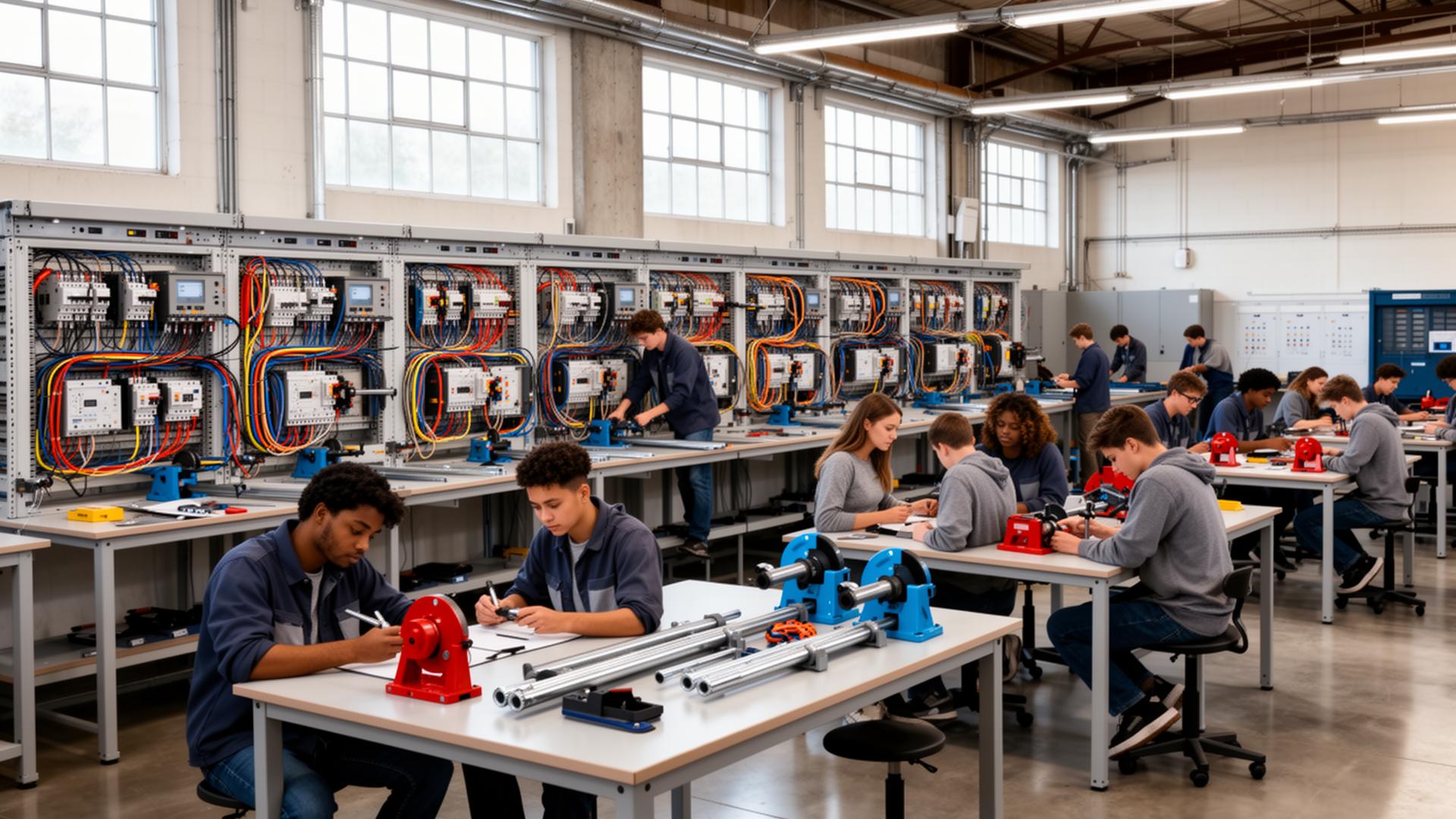
- Safety & Compliance
Safety Foundations & OSHA-10
Comprehensive job-site hazard recognition, personal protective equipment, lockout/tagout procedures, ladder and scaffold safety, and electrical-specific NFPA 70E standards. Students earn the federally recognized OSHA-10 Construction certification — a credential required on most commercial and industrial job sites.
- Theory & Systems
Electrical Theory & Power Systems
Electrical theory and circuits, Ohm's Law, AC and DC fundamentals, construction math, and NEC fundamentals. Students learn to read construction drawings, blueprints, and electrical construction drawings used on commercial and industrial projects.
- Tools & Technique
Tools, Meters & Test Equipment
Proper selection, care, and professional use of hand and power tools and electrical test equipment, including multimeters, clamp meters, and continuity testers, with tool-ownership planning for workforce entry.
- Commercial Wiring
Commercial Wiring & Conduit Systems
Conduit bending, raceways and fittings, device boxes, and conductors and cables. Students apply electrical construction drawings and NEC fundamentals in hands-on lab installations.
- Industrial Systems
Introduction to Industrial Settings
Introductory exposure to the equipment, environments, and safety expectations found in industrial and manufacturing facilities. Advanced topics such as motor controls are previewed as pathways for continued training after the program.
- Service & Maintenance
Test Equipment & Basic Troubleshooting
Using electrical test equipment to verify circuits, identify basic faults, and follow safe testing procedures during hands-on lab training.
- Residential Fundamentals
Residential Wiring Fundamentals
Residential electrical service fundamentals, branch circuit wiring, receptacle and switch installation, GFCI and AFCI protection, and residential NEC requirements. Students build functional residential circuits to understand principles that underpin all electrical systems.
- Career Pathways
Career Pathways & Workforce Readiness
Resume and portfolio development, interview coaching with industry partners, job-site professionalism, communication standards, and direct employer introductions. Students explore career tracks including commercial construction, industrial maintenance, electrical service, utilities, and low-voltage systems.
Construction Safety
The federally recognized 10-hour OSHA construction safety course — included in tuition. Recognized by employers nationwide as a baseline for site readiness.
Industry-Standard Curriculum
Our curriculum aligns to NCCER Core and Electrical Level 1 — the standards used by the top electrical contractors and union training programs in the country.
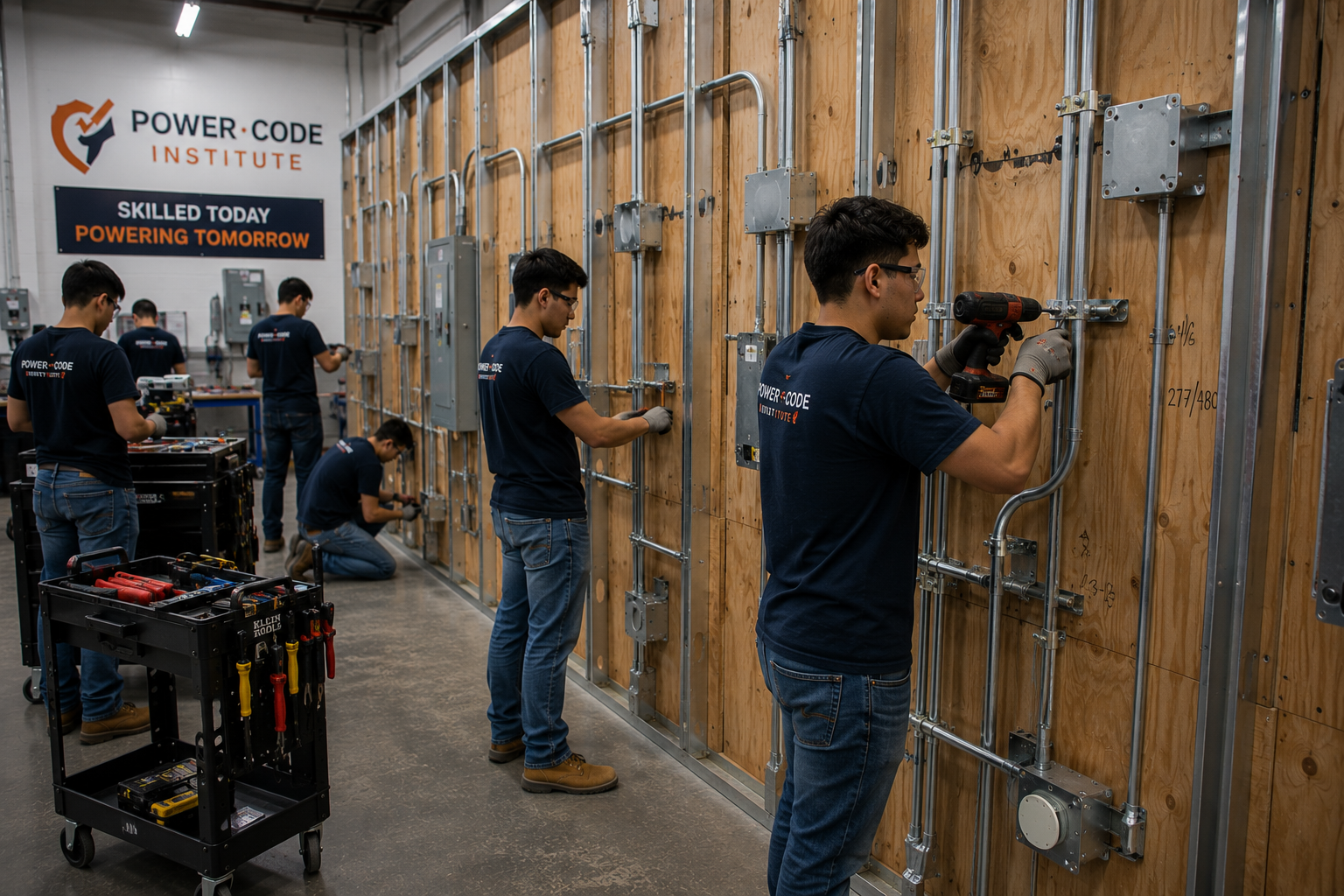
Hands-On Training
Most of your time is spent in the lab — pulling wire, bending conduit, and wiring real circuits. We teach the way the work is actually done.
Career Preparation
Technical skill is half the job. The other half is showing up, communicating clearly, and operating like a professional. We train both.
- · Resume + portfolio coaching
- · Mock interviews with industry partners
- · Job-site etiquette & communication
- · Direct employer introductions
Common questions
No. The program is designed for students entering the trade. Reliable attendance, a willingness to learn, and a professional mindset are the most important requirements.
Ready to enroll?
Limited seats per cohort. Get details before they fill.